Current call out
Theme: Harmony
Deadline: March 2027
Latest Issue
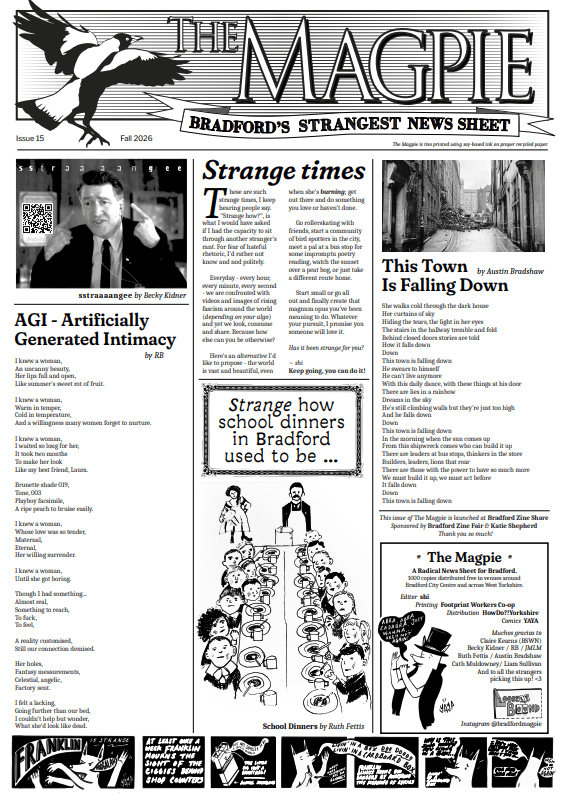
Read the latest issue below.
(Opens a ~30mb PDF here)
News
28.5.2026
The limited special edition Issue 14 is finally out! Launched at the Bradford International Paste Up Festival on the 23rd of May, you can find 100 copies at the 1in12 Club on Albion Street for you to pick up in person.
This issue has been printed by B.J. The Bear at Salt Riso in Shipley.
Read on below for the full unedited version of the interview with People's Care Movement.
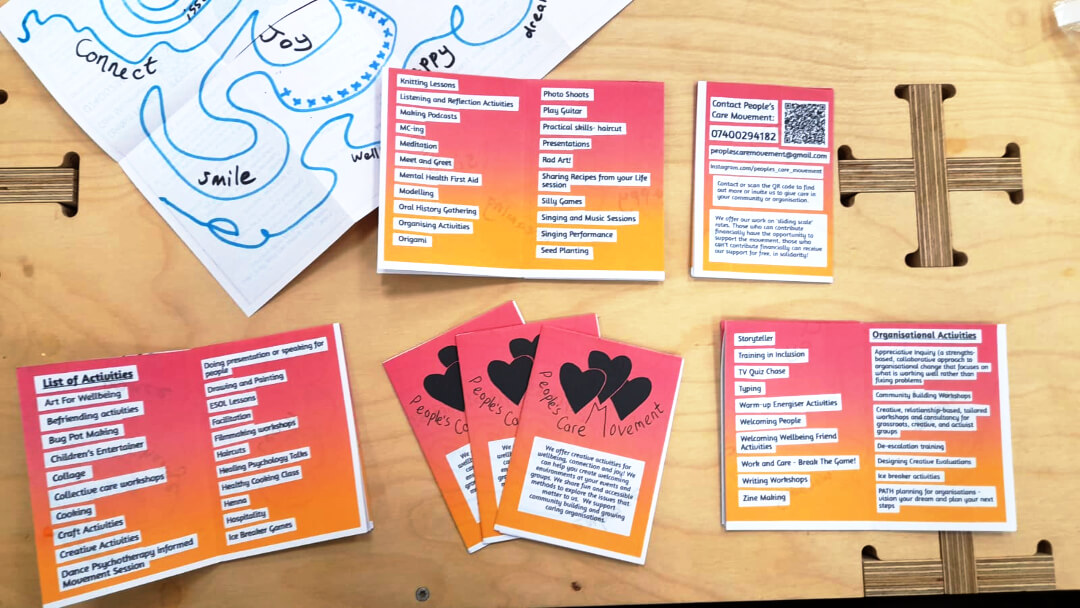
5 questions with People's Care Movement
1. What's the story behind the project?
I started working as a creative practitioner with Our Patch, Bradford City of Culture (now Bradford Culture Company) in spring 2025, with the brief to explore the theme of care across the city. It was very open! I began by trying to really listen, and observe, and feel the nature of care in the city. I was meeting people, and groups, talking, walking around, and watching life go by. Through chance meetings, holding public events, and reaching out through existing networks like the BD25 volunteers, I brought together a group of people with a range of connections to care, to creatively explore issues and ideas in care.
At first, the gatherings were open to all, and as a core group began to form, we started having additional ‘working gatherings’ where I was leading a lot of very playful, often quite theatrical activities, so that we as a group could get to really know one another, explore ways of hosting and holding space, explore how we organise together, build accessibility, and express ourselves! It's shaped by us together, all members contribute with their presence, energy and ideas, by leading activities, organising the food, supporting one another…
In the first gathering, one member said ‘We are starting a movement!’ and I remember being a little freaked! Like, oh, what have I done? Can I do justice to that? But then we adopted it as our name, and it became more like can we try it? Can we play with this? And well, here we are! We are a collaborative group of people with lived connections to care, including through being disabled and neurodivergent, migrants, carers, parents, children, and people who are excluded from care, and affected by inequality and discrimination. We use our lived connection to care to create more caring and inclusive communities.
And it’s not just that core group of members; if you come to one of the open gatherings, you are part of shaping it too! Because there's space to be yourself and have your voice heard, and we shape the caring environment in response to the needs of people coming, and programme activities and partnership work in response to what people are facing. At our gatherings, you can expect a friendly space to meet, relax, and enjoy a free lunch, enjoy creative caring activities led by PCM members, use fun, and accessible methods to explore the issues that matter to our communities, including the struggle for better social care, migrants’ rights, anti-racism, overcoming mental health stigma, isolation, poverty, and caring for ourselves and each other.
At one of the very first gatherings, I had booked BH childcare to look after the children of attendees, and Bushra turned up, took one look at the leaflet and said, ‘I was meant to be here today!’. She had deep connections to the theme, and as the children didn't arrive till a little later, she joined the group for a conversation session and another essential bond was formed. Shortly after I got a message from SEND Salaam which is Mahum’s community project, drawing on her own experience as a parent carer and focused on supporting SEND children & families, especially within minority communities. I invited her to a gathering and this sparked Mahum and Bushra working together to create a children's programme of equal importance as the adults' programme. They create playful, creative and sensory activities for children to explore the same themes as the adults, so they too can shape the movement!
What came out of, and fed into these gatherings was a wide-ranging network of activities throughout the city. We offered creative activities for wellbeing, connection and joy within communities we are part of and want to support, including asylum support networks like BIASAN, elderly living associations like Mary Seacole Court, services for people with multiple barriers like Bridge Project, and the 1in12 club, an anarchist social centre where a couple of us bring care-based approaches to anti-racist, anti-far right community building, and resistance.
We’ve made a newsletter, we’ve made three films!, we’ve made art, we’ve created workshops and theatrical games exploring structural inequality in care, we’ve taken action, held public conversations in 6 different neighbourhoods, contributed to conferences about Creative Health and Social Practice Art, run regular public Gatherings including our recent Spring Gatherings, when the adults programme ran alongside a children’s Holiday Club.
2. When, why and how did you start?
I love this question! Because it’s a project made of stories, like actually our manifesto has been created through sharing our stories about the values we chose. We do this because it's the diversity of people’s stories and the wisdom contained in them that can create a movement. We explored these stories through movement, resulting in a film created with Ahseem Yousuf, which is our very creative manifesto!
PCM as a group but also me as an artist do a lot of work with stories, and listening to people's lived experiences. Through all that process, these are some of the things I’ve understood, and that the project has emerged from:
The sector is underfunded, understaffed, privatised, care work is underpaid, often people doing it are migrant workers in modern-day slavery conditions. Being a carer can be isolating, it's made harder with a stretched care system. Some people want to care for family members but struggle due to work responsibilities, others are held back in their work because they have to . Disabled people face prejudice and navigate an ableist world, disability diagnosis can be a cruel experience, there is not enough support, people are navigating the complexities of receiving care in isolation, there are relentless cuts to disability support. Rising poverty and cost of living disproportionately impacts carers, care workers, and disabled people… I could go on but I think it's safe to say that the care system is in crisis, and PCM is able to explore not only this, but how it interacts with wider community infrastructure and especially what’s happening locally…
Of course everyone has different experiences and Bradford's a city where people lead some very harsh lives and feel uncared for. We can also feel the limits of our own care and the boundaries that protect and also exclude. But there is so much care here. People feel it’s a caring place, friendly on the street, and while it can be complicated, there is a huge expression of how joyful and natural it feels to care. Especially within a family, neighbourhood, or community. However, the care systems, welfare, and the way the world is organised, it really doesn’t reflect that. So to me, I think something's not right here, the people do not get to create the world we live in, and if we could, I’d take the chance on it being better than what we have now!
There are so many people who want to give care, support, creativity, and wisdom, but we may not have opportunities to do this. They face barriers to employment and volunteering because access needs aren’t met, there's external pressures, or we diverge too much from being able to fit formal routes, for example, asylum seekers, many of whom want to offer caring skills in society but are banned from working. For some there's also a pressure into working jobs that's not right for them when they want to give care in their community and care for themselves through disability. So we support each other to take care, meet access needs, try to address the pressures we face, do things differently so people can offer care and creativity and wisdom of lived experience, in a way that's right for them! We also explore many of these issues around work and care in our Navigation Game which draws on our lived experience, where you can step into the shoes of people navigating the complexities of care, and ‘break the game’ by taking meaningful action to tackle the root causes of these issues!
I was discovering that Care can be very rigid; you need to be diagnosed into a category to access care. You are either a carer or cared for. This was mirroring what I was seeing across the country; we are diagnosing and categorising people, who is British? Who matters? Who belongs? Who is deserving of care? So it became really important to build something fluid! A movement.
Another important story is what PCM means to people. Many talk about it as a family, the first thing that made them feel empowered to take action on an issue that affects them, a rare place they feel they belong.
3. Has this altered the way you view the city and has it affected the way you see people (if at all)?
Yes totally! I am from Bradford, but I had been living away for 10 years and getting the opportunity to do this work was what triggered me to move back. It was really cool because the city has changed, and so have I, So I got to meet the city again and discover myself anew here too.
I need people to keep me grounded, and present with the joy of the work, and Bradford goes above and beyond in that. There's so much goodwill, and it's so down to earth here! I guess I experienced that growing up, but I couldn’t see it as I can now, because it's all I knew. Returning after having lived in other cities (even though I love them too!), I was like Ohhh! It's DIY. That comes out of some adversity that I don't want to romanticize, but there is an opportunity to do things differently here, because people have always had to! It’s such a creative place.
It's a small city in some ways, so there's a sense of realness, and things happen through relationships and connections, which is so beautiful. It can feel like different small scenes and networks, and I’m into asking what we can do to open them up? There's only one member of PCM who I knew before the project started, and one who knew me when I was a baby (classic!), and I think that's a fair achievement if you are from Bradford! So I guess through doing this work, I’ve met lots of new people, not just members. I feel blessed to know all of them! And each one of them has shaped the project and changed me!
4. Building and sustaining communities is hard - how do you do it?
Yes It is hard! It's really hard! So I think the first thing we do is ask, okay, why is it hard? What are our barriers to being in community? Are you knackered after work? Are you sick? Is it accessible to you? Do we have places we can meet without spending money? Has something happened to you that makes community hard to even imagine? Are you isolated because your caring responsibilities are not shared/supported? Is there discrimination happening? Do we live in a world built on competition? Does that live inside us, too?
Then we try to get clear about what’s needed (this involves listening), and lift those barriers to the best of our ability. This can be practical (eg. transport costs covered, food provided), relational (how we treat each other, accept, and challenge each other), or often it’s both at once and more! It always requires listening, flexibility, and creativity.
I think we are in a constant battle over our time, imagination, values, energy… so while we use every tool we have right now to lift these barriers, we can only make it sustainable if we also ask why those barriers are there? Who or what is against us in this battle? I think it's the system we live in, capitalism, which is built around profit, not community or care, and relies on inequality, keeping masses of people in poverty, and others beyond rich! And I think this all creates, and is created by, other super deep inequalities like racism and sexism. Both care and art are weird because they kind of disrupt the logic of capitalism by the nature of what they are, but they also absolutely replicate it.
Inequalities, not having places to gather, the pressures of daily living are barriers to being in community. But that's not just an accident, or collateral damage. The system that produces the inequality doesn’t want us to be in community because when we start to gather, know one another, share joy, start to connect our struggles and see they have the same roots, we stop buying into the competition. It can be disruptive to the system in all the right ways!
Other members come with totally different perspectives and realities, like for some people, engaging in that competition of capitalism and securing something for themselves is part of building a better world, because they are smashing down barriers to do that. For some, even the word ‘politics’ is something to run from like the plague (and I can totally understand that, considering the ‘politics’ we watch on the news is harrowing and ridiculous, and we are shut out of participating in it). In PCM, we try to listen to what others think (which means being open to being changed by it) and be honest about what we think (which for me doesn’t always mean starting every conversation by saying ‘hello, my names Josie and I deeply believe in revolution’, but it could!).
So we listen, and we share, but we don't just talk. Yes, we’ve had some amazing conversations, so much wisdom, passion, power, and healing just in speaking about our experiences. And the C word (capitalism) has come up, but it’s not just all in theory, it's experienced in the conversation itself, along with how we move in the room, how we share food, how we play, how we create, how we hold each other, how we be together in our differences and practice something different to the system. Everyone has a part to play, and finding what that is means being ourselves, and shaping our community through participating as ourselves.
And yeah, it can be hard, and we put a lot of work into it! But community also can feel natural, it's what we do when we are most aligned with ourselves and the universe, or whatever it is that we feel connected to! (The spiritual faith of so many in PCM has been really moving to me). So community is hard and it's easy, it's impossible and it's inevitable, it's nowhere and it's everywhere. And being contradictory like that is the most human thing ever, right? So I think what we need is to be human about it! Welcome it all, be honest, be caring, have a laugh, where there are contradictions we need play and creativity!
We need to have joyful conversations about diversity and difference, and brave conversations about discrimination and othering. Have grace for each other, make mistakes, and keep experimenting. I think building and sustaining communities is essential for revolution, and I think revolution is essential for building and sustaining communities! And it's all an act of imagination and experimentation, so yes, it’s hard, and urgent, and that's when we need to be most playful!
5. Do you have plans and hopes for the space?
Yes! Actually as I have been writing this Bradford Culture Company confirmed they can support the project a little longer, which is amazing.
We will be holding Summer School Gatherings for children and adults. Bringing together members, partner organisations, and others connected to the theme of care, it will be an accessible space of care where people can drop in, receive support in navigating care systems, connect to political organising and advocacy, find community, and enjoy shared meals and creative activity. The dedicated children’s programme is run as a Council-supported holiday club so all eligible children can join to explore care, community, and wellbeing through play and art.
We also offer activities to other groups and organisations from creative and caring activities to foster wellbeing and connection, to fun and accessible methods to explore the issues that matter to us, to supporting community building and growing caring organisations. We offer our work on 'sliding scale' rates. Organisations that can contribute financially have the opportunity to support us to offer activities for free and at lower rates to the communities that need it most!
In the next few months, we will be trying to build a People’s Care Movement that can have a life independent from, but hopefully in partnership with, Bradford Culture Company. Like you said in your question, building and sustaining communities is hard! But we know we are not alone! We need everyone, we need you! Please come to our Summer School Gatherings, invite PCM to lead activities in your group, organisation or event, shout about the amazing work we do, and get involved and participate in making the movement!
For more information about People's Care Movement, visit this link.
13.3.2026
Call out for Issue #14! We're launching the next edition at the Bradford International Paste Up Festival in May. We look forward to your contributions!
20.9.2025
Issue 13 has been printed, folded and sent to HowDo?! for distribution earlier than expected thanks to Footprint Workers Co-op! Sources say some have been found in the city centre and as far as Halifax.
Read on below for the full unedited versions of the interviews with BD1 Skate and Hope Shooter.

5 questions with BD1 Skate
1. What's the story behind the place?
The top two floors of the Oastler market carpark have been condemned for about 10 years, over the last year we built a skate park there. Capital of cycling took a risk giving us permission, and recently we have had email support from bradford councillors as well as carpark and market council workers, which we hope will help us find a new home before it gets demolished.
Connie sent an awesome email to our local councillors which is below:
We are a group of skate volunteers who have been working with the Capital of Cycling to turn the derelict top floors of the Oastler Car Park into a DIY Skate Park. After 10 months of community effort, the park finally reached a beautiful point: We now have 2 mini ramps, 2 quarter ramps, grind boxes, rails, a kicker ramp and even a 100-year-old Ronisch grand piano manny pad.
We've built a team of around 12 volunteers and keyholders, working closely with the team at Capital of Cycling to share the space. We've kept the space safe, clean and well taken care of. It is much loved and has provided skaters (boards, quads and inlines) from a widely diverse background with a safe, sheltered, smooth skate space. Skaters have come from across the gender, neurotype, race, religion, culture, parenting, income and ability spectrum. People have travelled from out of town to visit (with a recent visit from an international skate sociologist). We have also had artists come in to paint on the walls and pillars.
Everyone has been coming to use the space for their mental health, whether skating, cycling or painting. Prior to this, our users have felt unsafe, embarrassed, intimidated, and fearful of repercussions/arrest under bylaws in the available public spaces in and around Bradford. For those of us who are able, we feel forced to travel to Leeds to find support.
You can see our journey on instagram at www.instagram.com/bd1.skate.volunteers, please see the Skate Clips highlight for some of the most fun parts, or the Art highlight for some of the artists' work on site.
We're appealing for any support from yourself and allies in Bradford Council to be able to continue skating and cycling safely. Our community defies the outdated deviant stereotype of the skater community and truly represents the diversity of Bradford. We'd love to be able to continue to nurture this.
Feedback from Dave, Director of Capital of Cycling confirms "The difference to the space made by the skaters being there is really notable. Cycling and skating could both benefit from a city centre space for activities."
We can do a lot with any unused, sheltered, smooth location, and we are not asking for funding or investment. We're simply looking for a disused space that already exists, that can be activated - even temporarily. We've seen exciting spots like Loading Bay being used - what will happen to this space after BD25? We're also aware that the Kirkgate Centre is next in line to be demolished, with a less than 50% occupation and two levels of car park above. There are lots of unused spaces around the city centre and we feel we could bring some much-needed love and community to them.
Please hear us and help us find the next safe space for our community to move on to. We will take great care of it.
2. When, why and how did you start?
The Skate Sanctuary in Leeds ran a series of rollerskating classes in Girlington focused around global majority women, and also open to other women. They had a WhatsApp group which I got added although I never attending a session and after the sessions ended there was a handful of us that met up in various carparks and tennis courts. One member works for Capital of Cycling and we spotted the beautiful smooth carpark floor they were using and asked for access which they gave us!. Connie put a socials presence together and a call out using her skateboarding connections and over the year we have had access we have added key holders and invited anyone who wants to to open up and post a session for anyone else to attend.
We have had ramps and boxes donated from individuals who had built them, or bought them, from a bunch of bladers in Halifax, and a 100 year old Ronisch grand piano manny pad donated by Leeds Civic Society, and vans to transport them either hired by BD1 volunteer Khalid or loaned from Ravenstaging.
We’ve loved painting and otherwise creatively vandalising the space with beautiful trash, paste ups, and lots of street artists have dropped by and used the space. (Safranart, Bisto, Onist, Yaya amongst others)
Connie arranged our minority gender day with Australian Skate Sociologist Dr Indigo Willing which was awesome and sort of gave confidence to our identity as mainly minority gender skaters but open to all. Some local bradford legend skateboarders prefer to come out of hours, as they have always done in the Oastler Carpark. The ramps and obstacles can be moved and rearranged which has been used really creatively.
3. Has this altered the way you view the city and has it affected the way you see public spaces (if at all)?
I'm going to answer that from my personal perspective as a middle aged parent/carer residing in Shipley whose core memories from kid upwards were formed in the unused or misused industrial spaces in Bradford. I don’t drink, and I’m sort of restless, so I don’t really come into town to bars or concerts, so its been lovely to have a place in town to sort of hang out again and begin to reconnect with BD1.
As teens we were always looking out for wasted spaces, studios, free parties, and we dreamed of having our own community place or whatever, but it was never anything I had the skills or means or confidence to contribute to.
We don’t need an overdeveloped community space. I think people just need an accessible place that is affordable and the rest will come if there is a need and drive. Skate culture is a massive teacher of how a DIY place can function and I’m just learning. ..this isn’t the first Bradford skate DIY but you would have to speak to some of our old school members about the old Mecca bingo hall…
As a parent/carer, my options are limited in someways, but that stuckness that comes with caring for someone who is disabled has sort of focused my energies on what I need - a place to move and skate, and somewhere to create. If I have that, and even better, the capacity to share a place and meet other people then I still feel like I am growing despite the sociatal and physical limitations around caring and disability.
4. Building and sustaining communities is hard - how do you do it?
The freeness of the carpark has been key, both in cost and access. We don’t pay for it, so no one owns it, anyone can have a key and run a session or turn up and create or take photos or do whatever. The community has sort of been a byproduct- the people who wanted to come and use the place, and by turning up, or adding themselves to the WhatsApp or the insta they are part of the community. Its not been without its teething problems, we didn’t know the boundaries of what we could get away with in regards to any official interactions with the space eg council? health and safety? Market manager? Capital of Cycling? we just didn’t know who might feel like we shouldn’t be there and what might trigger that which led to a lot of confusion and anxiety in the first few months but it all works out. I feel like we were getting more community vibe just as the notice to vacate was given to CoC etc which was a bit of a blow. We don’t know how long we have now. I feel like I've learnt a lot about what can put people off and the landscape of the local skating community along the way. Also what I can commit to and what i just can’t.
The carpark doesn’t have toilets, and is not accessible to those without risk awareness so we’ve not been able to be as inclusive as we would have liked and would be if we had a more secure space.
5. Do you have plans and hopes for the space?
We don’t know how long we have! But if we had a new space- an empty store or warehouse, or even a uncovered carpark, we know we could gather ramps and make another creative skate space. We would dream of wheelchair sports, coaching, kids sessions, and gathering funding for equipment to make it more accessible to beginners. The minority gender event highlighted the need for more of that here, and so would defeinelty be on the wish list as well as a mens session hosted by local skate legends. The dream being, if we had a place we could give access to any community groups who wanted to use it to host sessions too.
And also toilets and lights please.
We’re hoping to have another event or skate jam at least before it is demolished.
Some examples of skateparks in reused places.
Piazza centre huddersfield (old toy shop) skate it yourself,
Shredenhams in Bristol,
Level 7 Cabot circus carpark Bristol,
Pitt street (old sainsburys) Portsmouth.
5 questions with Hope Shooter
1. What's the story behind the project?
The writing group ‘Get it in Writing’ is part of a larger project called Mindful Manningham which aims to reach people in marginalised groups to form a stronger community within Manningham. The main aims are to foster connection between people and to help people better their mental health through creativity and human contact
‘Get it in Writing’ got its name because so many people with disabilities, additional needs, chronic illness are constantly needing to validate themselves to the outside world, and ‘prove’ that they need assistance. They are told any issues they’re having they must ‘get it in witting’ to access support. Our group aims to turn that on its head and form our own support network and space where we can express ourselves creatively, and talk about ourselves and much as we’d like to, without any external pressure. It’s a place where people are able to bring their stories and experiences and get them in writing without the judgemental presence that Neurotypical and able-bodied spaces can sometimes provide.
As well as offering that metaphorical place to express themselves we also have a literal space where people can come, access a warm space, and hang out for a couple of hours.
We’re incredibly flexible when it comes to what people want and need, and it’s deeply important to us that people feel able to express those desires, which they may not feel able to do elsewhere.
2. When, why and how did you start?
The Writing Group specifically started at the end of April this year, though I’ve been doing workshops at Bradford New Church since September last year.
The workshops as a whole started because someone I had previously worked with thought I would be a good choice to come into the community and run some craft workshops. Over the months those developed and I’ve been able to work with so many different members of the community and see what the people are actually wanting. With the success of the workshops Mind the Gap asked me if I would like to run writing workshops for adults with learning disabilities and/or autism and I said absolutely!
I think as a whole a lot of creative workshops/outreach is either aimed at children or rich people. That’s all well and good but that leaves a lot of left over groups. Money is a huge barrier for people so all of the workshops I offer are free to attend, and usually whenever I apply for funding that is an element I will not budge on. Everyone should be able to access creativity, not just those with disposable income.
I’ve also seen that some people seem to carry a certain amount of shame/embarrassment when it comes to being creative, and see it as childish. If I can help dismantle that idea in any way then I have played my part. Creativity is intrinsic to the human experience, and doesn’t stop as soon as you turn 18.
It is a universal experience that disabled and neurodivergent people feel othered by society, and that there isn’t always a place they can fit in and be themselves. Get it in Writing is not only a place that accepts them but is directly built for them and grows with each new member.
3. Has this altered the way you view the city and has it affected the way you see public spaces (if at all)?
It absolutely has, though I’m not really sure how to explain it. It’s almost like seeing the city as a living ecosystem, with each element feeding into one another. Everything is linked
People in Bradford have a lot of pride for where they’re from, even if in the same breath they also insult it.
I think Bradford 2025 as a whole has also helped to show how much public spaces can be utilised in bringing people together, and just how important those spaces are.
With costs of living rising and a culture of anxiety sometimes we just need to have places where we can exist with other people and not have it cost anything. Bradford New Church is absolutely one of those spaces
Bradford is a well aged sofa. Perhaps it’s not perfect, but it’s comfortable, dependable, and will always be there.
4. Building and sustaining communities is hard- how do you do it?
My friend once said ‘to work with community you have to meet them where they are’ and I wholeheartedly agree with that. A lot of the people who come to the space are people who may not have even realised this was something they needed, and if it was just advertised on a poster would have ignored it.
To work in community you need to be consistent, you need to be there, and you need to be patient. There will always be some people who come from day one and are enthusiastic, but some of the biggest victories are when someone you’ve seen for months walking by actually sits by you finally and talks
So many funders focus on having a tangible ‘output’. A graph where you can show how many people came, how long they spent there - I have seen some of the most ridiculous questions on those feedback forms. But actually building community is much messier than that and isn’t something you can put a number to.
Community is walking in and someone making a tea for you automatically. Community is someone smiling and talking waving to you across the street. Community is existing together as a live being, and not just coming in to do a service
I try to keep myself as an active part of the community besides running workshops and will check on and talk to people outside of sessions. Seems a bit silly to help build a community and then not to be a part of it
5. Do you have plans and hopes for the space?
I’m really hoping that with more funding and time we’re able to make the space more accessible for people with mobility issues. We’ve already been able to get a temporary ramp but hopefully we’ll be able to get something sturdier for more heavy duty mobility aids
My hope is that we’re able to carry on with the group because it has clearly been helpful and needed. With Bradford 2025 we’ve had the chance to create many different spaces and groups for people, but we need to make sure it continues into 2026 without the ‘City of Culture’ tagline carrying us. Unfortunately in the creative world things aren’t just as simple as people wanting something to continue so it will, but I am optimistic about the future
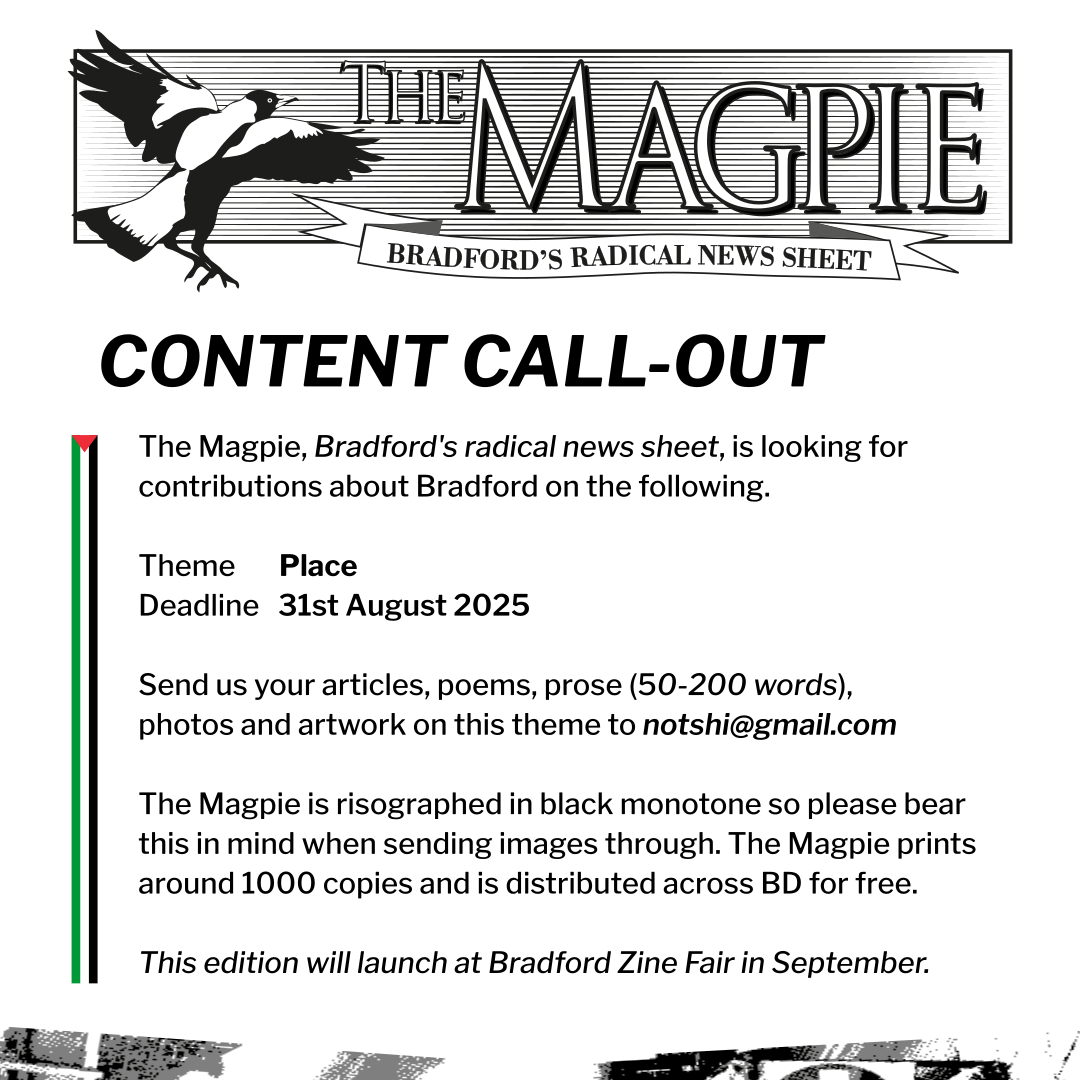
31.8.2025
Today is the deadline for issue #13! We are very much looking forward to launching the next edition at the Bradford Zine Fair amongst friends and other wonderful zine makers. Join us!
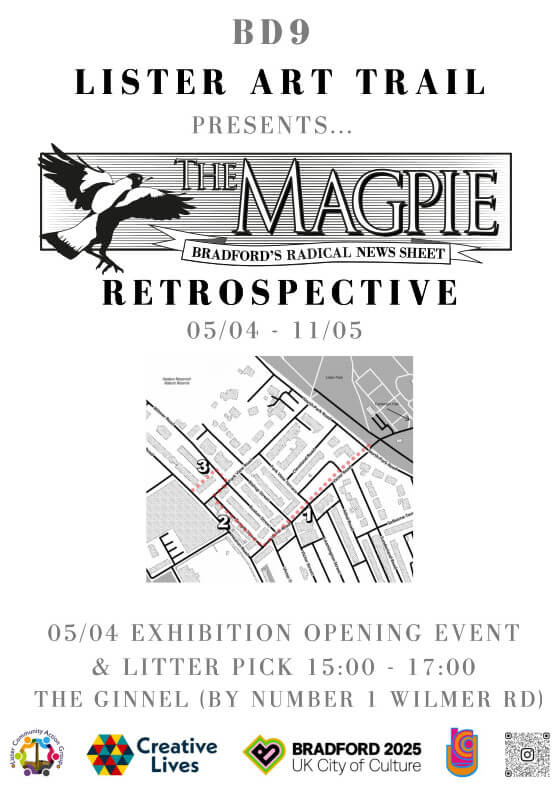
24.3.2025
The launch of The Magpie Retrospective will take place on Saturday, 5th April from 3 to 5pm. Join us at The Ginnel (next to 1 Wilmer Road, BD9 4RX)! We invite old and new magpies to share their contributions in person in this very informal gathering.
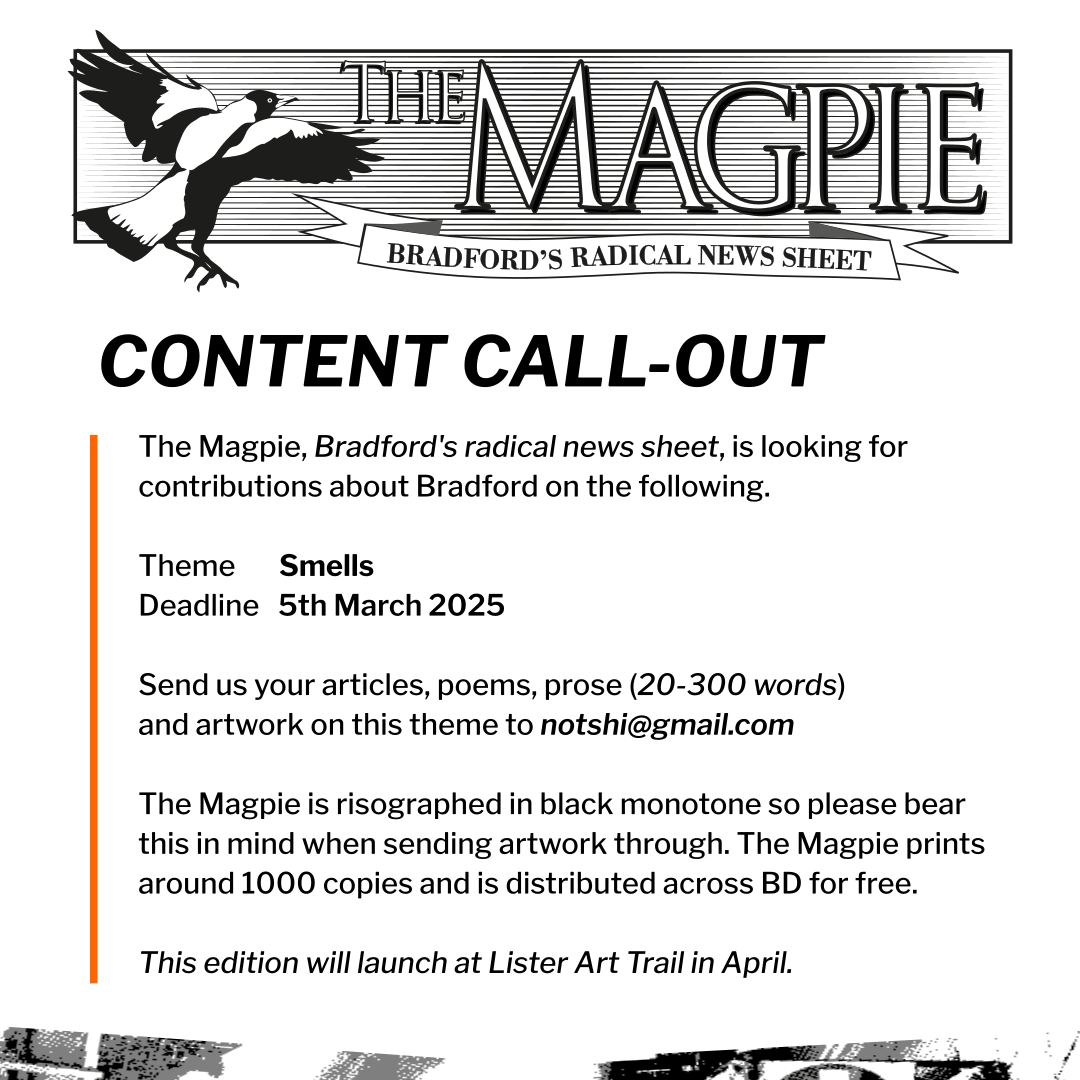
19.2.2025
Call out for Issue #12! We are very excited to be launching this next edition at the BD9 Lister Art Trail in April, as part of the community exhibition, celebrating new and past issues of The Magpie.
Issues
| DATE | ISSUE | LINK |
|---|---|---|
| 3 October 2026 | ISSUE #15 - Strange | DOWNLOAD |
| 23 May 2026 | ISSUE #14 - People | DOWNLOAD |
| 27 Sep 2025 | ISSUE #13 - Place | DOWNLOAD |
| 5 Apr 2025 | ISSUE #12 - Smells | DOWNLOAD |
| 11 Sep 2024 | ISSUE #11 - Ghost/s | DOWNLOAD |
| 25 Mar 2024 | ISSUE #10 - Name | DOWNLOAD |
| 28 Aug 2023 | ISSUE #9 - Sound | DOWNLOAD |
| 5 Oct 2022 | ISSUE #8 - Re:Birth | DOWNLOAD |
| 24 Feb 2022 | ISSUE #7 - Celebrate Autism | DOWNLOAD |
| Autumn 2021 | ISSUE #6 - Street Art in Bradford | DOWNLOAD |
| 12 Oct 2020 | ISSUE #5 - City of Culture | DOWNLOAD |
| 19 Mar 2020 | ISSUE #4 - Transport in Bradford | DOWNLOAD |
| 24 Oct 2019 | ISSUE #3 - Occult | DOWNLOAD |
| 21 Aug 2019 | ISSUE #2 - Panic Climate | DOWNLOAD |
| 1 May 2019 | ISSUE #1 - Still Mean | DOWNLOAD |